Новости
Anyone working in the industrial laundry sector knows that picking the right equipment matters far more than just increasing manpower. It directly shapes operating costs, washing quality, and long-term market competitiveness. Many new business owners and expanding laundry plants often struggle to tell the difference between continuous batch washers and conventional industrial washing machines. Some blindly chase high-end models, while others settle for budget options only to end up with insufficient capacity or unnecessary overinvestment.
In truth, neither type of equipment is inherently better. What really counts is whether it fits your actual business needs. Once you understand their core differences, applicable scenarios, and return on investment, you can make a sensible purchase and keep your laundry operation running efficiently.
Conventional industrial washing machines, mostly standalone washer-extractor units, work as independent operating stations. A single drum completes the whole process of water intake, washing, rinsing, and spinning. Compact in structure and footprint, each machine functions as an individual washing unit that can be put into operation quickly with basic water and power connections.
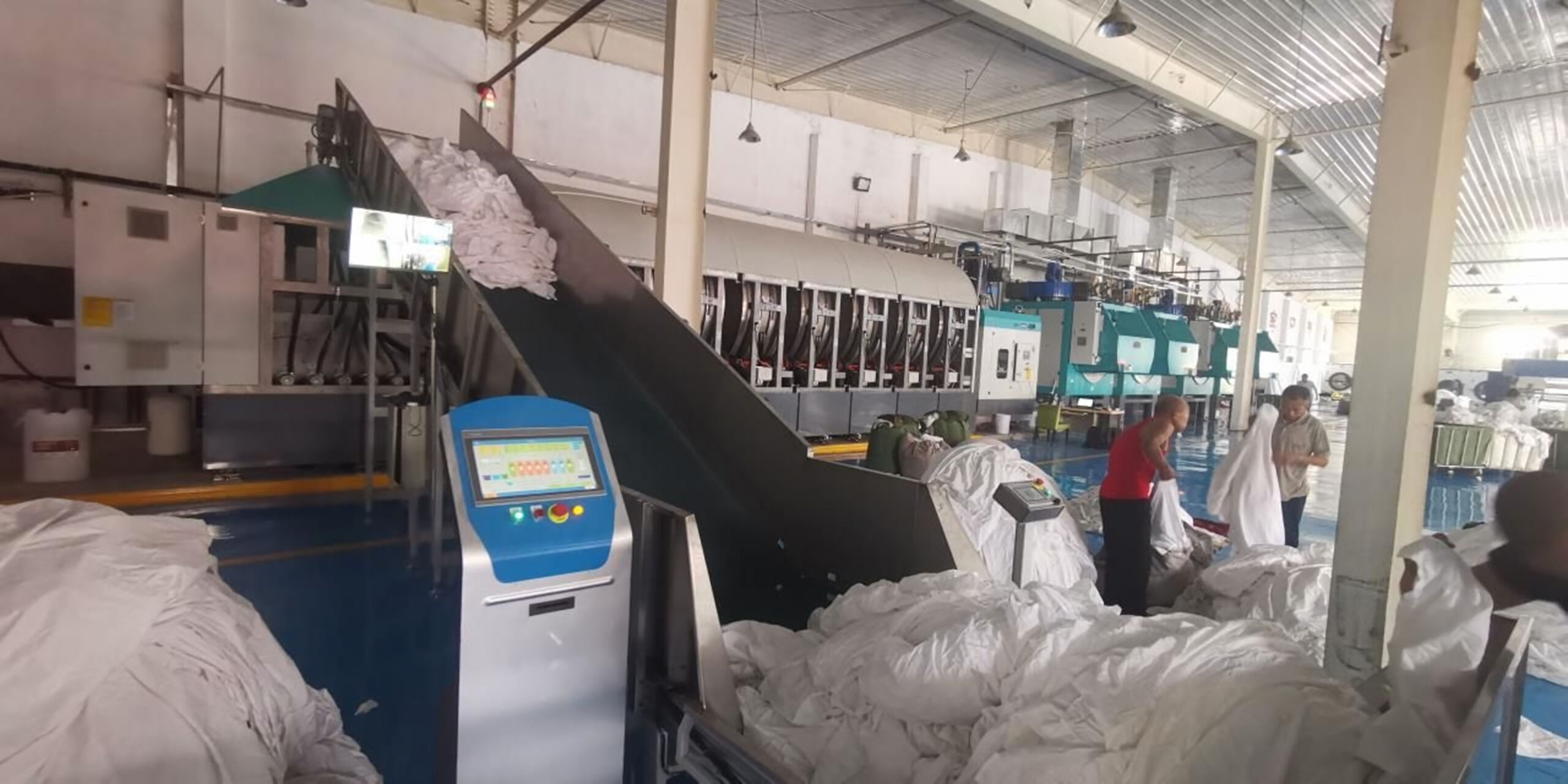
A continuous batch washer, by contrast, is a tunnel-type integrated laundry system made up of multiple connected chambers. It operates like a non-stop automated assembly line. Linens enter from one end and move sequentially through prewash, main wash, rinsing, and pressing procedures without manual handling until clean fabrics exit at the outlet. It represents high-level integrated large-scale laundry equipment.
The gap in production efficiency is remarkably obvious. Take a common 100kg industrial washing machine as an example. One full washing cycle lasts roughly 40 to 60 minutes, yielding only 80 to 100kg per hour. Even running five units nonstop, the daily maximum output barely exceeds five tons. Workers still need to load, unload, and monitor the machines constantly, which keeps labor demands high.
A continuous batch washer works in an entirely different way. Its multi-chamber serial design processes one batch of around 60 to 65 kilograms every two and a half to three minutes. The hourly output steadily reaches 1,500 to 2,000 kilograms, with a daily handling capacity of 15 to 20 tons. That is equivalent to running 15 to 20 sets of 100kg industrial washing machines simultaneously. Capable of 24-hour automatic operation with minimal manual intervention, it delivers a capacity leap that standalone machines can hardly match.
Operating costs are another critical factor that every laundry operator must calculate carefully. When it comes to water consumption, traditional industrial washers use about 25 to 30 liters of water per kilogram of dry linen. Running ten units processing 15 tons of linens daily consumes more than 330 tons of water, bringing substantial expenses on water supply and sewage treatment.
Continuous batch washers adopt counter-current rinsing and water recycling systems. Wastewater from rinsing and pressing is reused in the prewash section. Water consumption drops to merely 6 to 10 liters per kilogram of linen, cutting water usage by over 70%. Under the same production volume, daily water consumption falls to around 120 tons. The same advantage applies to power and steam usage. Standalone machines repeatedly heat cold water and start motors frequently, driving up energy consumption. Continuous batch washers recover waste heat and adopt integrated driving logic, saving around 30% of electricity and 50% of steam consumption. The long-term cost savings are considerable.
Labor cost disparity is equally noticeable. One worker can oversee at most four conventional washing machines. Running ten units requires at least three to five staff members for loading, transporting, and on-site supervision. A continuous batch washer only needs one or two operators mainly for weighing and feeding materials. The whole washing and discharging process runs automatically, drastically reducing labor reliance. Many laundry plants manage to cut six to eight job positions after switching to a batch washer, saving a huge amount on annual labor expenses — a meaningful advantage in an industry with thin profit margins.
Washing performance and hygiene standards also set the two devices apart. Traditional washers share the same drum opening for loading dirty linens and retrieving clean ones, easily causing cross-contamination. Fabrics often tangle during washing, leaving stubborn stains untouched and making linens look grey and stiff after repeated washes.
Continuous batch washers feature a physical isolation layout. The dirty linen inlet and clean linen outlet are separated by more than ten meters, creating an obvious clean and polluted zone division and eliminating cross-contamination fundamentally. Segmented washing in independent chambers optimizes prewash, main wash and rinsing separately. The 360 rotating structure allows fabrics to fully unfold and tumble, maintaining a cleaning rate above 98%. Detergent dosage and water temperature are precisely controlled to avoid chemical residues, perfectly meeting strict hygiene requirements for hospitals and high-end hotels.
Even so, continuous batch washers come with obvious drawbacks, the biggest being high investment thresholds. The initial cost of a standard batch washer is several times higher than conventional units. It also needs supporting equipment such as press machines and conveyor lines, while imposing stricter requirements on factory space, floor height, power supply, steam supply and drainage infrastructure.
Industrial washing machines win with cost performance. They feature low initial investment, fast payback, and flexible installation that fits compact premises. Maintenance is straightforward, and a single machine fault will not paralyze the entire production line. Independent start-stop operation suits small-batch and mixed-category laundry demands perfectly.
Business scale largely defines which device you should choose. Small laundry workshops, boutique hotels, homestays and catering businesses with daily output below five tons hardly need overinvesting in large automated lines. Affordable and easy to operate, standard industrial washing machines fully satisfy daily demands.
For large laundry centers, tertiary hospitals, hotel chains and railway service systems processing over ten tons of linens every day, the priorities lie in production capacity, washing quality and long-term cost control. A continuous batch washer can dilute equipment investment rapidly through large-scale output, energy saving and superior hygiene performance, greatly strengthening overall competitiveness.
Plants with daily output between five and ten tons can adopt a mixed solution combining standalone machines and compact batch washers, balancing operational flexibility and production efficiency during business expansion.
Most decision struggles stem from unclear demand positioning and long-term planning. If you focus on short-term budget control and quick operation start-up, standalone industrial washers make practical sense. If you aim for long-term expansion, quality upgrading and high-end market layout, investing in a continuous batch washer is undoubtedly a wiser move. Many operators choose to start with standalone units and upgrade to batch washers after accumulating stable orders and capital. After all, the best equipment is always the one that fits your own development pace.
Intense market competition has made equipment selection a decisive step for industrial laundry businesses. Both industrial washing machines and continuous batch washers have their own irreplaceable value in suitable scenarios. It all comes down to matching equipment with your production scale, budget, site conditions and quality standards.
Boasting rich experience in the research and manufacturing of industrial laundry equipment, Guangdong Guangyi deeply understands the real challenges faced by laundry operators of all sizes. The brand supplies durable and cost-effective industrial washing machines to meet flexible production needs for small and medium-sized enterprises, while offering newly upgraded continuous batch washers to empower large laundry plants with higher capacity and better washing quality. Supported by solid technical expertise, strict quality management and comprehensive after-sales service, Guangdong Guangyi has become a trusted partner across the industry, continuously driving the high-quality development of the industrial laundry sector.

+86 158-2025-1513

1744149454@qq.com

Но. 2, дорога Синхай, городок Ланхэ, район Наньша, Гуанчжоу, Китай

Product
News Center
Copyright